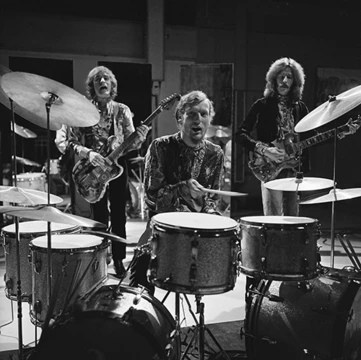
Beck, Bogert & Appice
Power trio formed from Jeff Beck Group, featuring Bogert and Appice.

Beck, Bogert & Appice was a rock supergroup and power trio fronted by English guitarist Jeff Beck, formed from the remains of the Jeff Beck Group. The lineup featured American bassist Tim Bogert and drummer Carmine Appice, who had previously played together in Vanilla Fudge and Cactus.
Beck had wanted to work with Bogert and Appice since meeting them in 1967, and after several sessions in July 1969, he told *New Musical Express* that two unnamed musicians under contract would be joining his group. *Melody Maker* reported in September 1969 that Appice and Bogert had been added, and Beck and manager Peter Grant planned to finalize contracts that November. However, Beck crashed his car on November 12, 1969, putting everything on hold. After recovering, he formed a new Jeff Beck Group in early 1971.
That second Jeff Beck Group officially dissolved on July 24, 1972. The next day, Beck met with keyboardist Max Middleton, Bogert, and Appice, and brought in vocalist Kim Milford. Rehearsals began at the Rolling Stones’ Bermondsey space for a U.S. tour originally booked for the previous group. Beck told *New Musical Express* that the new band would play heavier, more aggressive music than his earlier subtle rock. The group debuted as the Jeff Beck Group on August 1, 1972, in Pittsburgh. After six shows, Milford was replaced by Bobby Tench, who joined for the rest of the tour, which ended in Seattle on August 19. Tench and Middleton then left, and Beck formed a power trio with Bogert and Appice, who shared lead vocals. Still billed as the Jeff Beck Group, they played at Rock at The Oval on September 16, then toured the UK, Netherlands, and Germany. A U.S. tour ran from October 20 to November 11, 1972.
Recording for the eponymous debut album *Beck, Bogert & Appice* began at Chess Studios on December 11, 1972, with sessions continuing through December 22. Work resumed on January 2, 1973, with producer Don Nix, who later told *ZigZag* he was unsure how he got the job and wanted out. The album was released in the U.S. on March 26, 1973, and in the UK on April 6, reaching No. 12 on the U.S. chart and No. 28 in the UK. *Rolling Stone* critic James Isaacs called the album surprisingly docile compared to the live show, noting Beck’s subdued playing and Appice’s adequate but unremarkable singing, while praising tracks like “Lady” and “Livin’ Alone.”
A UK tour ran from Febru
- notable_album
- Beck, Bogert & Appice (1973)
Lore & Background
The debut album 'Beck, Bogert & Appice' was not certified gold by the RIAA.
Reader's Guide
Beck, Bogert & Appice represents a notable chapter in the career of guitarist Jeff Beck, marking his shift toward a heavier, more direct rock sound after the more subtle approach of his previous group. The band's debut album, though described by Rolling Stone as 'surprisingly docile' compared to their live show, achieved commercial success with a U.S. gold certification. The trio's live performances were known for their intensity, and the band toured extensively across the UK, Europe, Japan, and the U.S. Their legacy includes the live album 'Live in Japan' (1973) and the posthumous release of a concert from the Rainbow Theatre, which previewed songs intended for a second studio album that was never completed. The band dissolved in May 1974 before completing that second album, as reported by New Musical Express and Melody Maker. Despite its short lifespan, the group is remembered as a supergroup that brought together notable talents from the British and American rock scenes.
Did You Know?
- The band evolved from the Jeff Beck Group after the departure of vocalist Bobby Tench and keyboardist Max Middleton.
- The debut album 'Beck, Bogert & Appice' reached No. 12 on the U.S. album chart and was certified gold.
- Jeff Beck used a talk box for the first time during the band's U.S. tour starting March 28, 1973.
- The band dissolved before completing a second studio album, as confirmed by bassist Tim Bogert in May 1974.
Frequently Asked Questions
Who is Beck, Bogert & Appice?
Beck, Bogert & Appice was a rock power trio led by English guitarist Jeff Beck, with American bassist Tim Bogert and drummer Carmine Appice completing the three-piece lineup. The band grew directly out of the Jeff Beck Group in the late 1960s.
What is Beck, Bogert & Appice's most well-known album?
Their 1973 self-titled record, simply called Beck, Bogert & Appice, stands as the band's most recognized release and a defining statement of late-60s/early-70s hard rock.
How did the trio come together?
Jeff Beck had wanted to collaborate with Bogert and Appice since first meeting them in 1967, and the lineup was officially locked in after a series of recording sessions in July 1969. Bogert and Appice already had a tight musical partnership from their earlier work in Vanilla Fudge and Cactus, which made the collaboration a natural fit.
Why is Beck, Bogert & Appice called a supergroup?
The band is labeled a supergroup because it assembled already-established, well-known musicians from separate successful acts—Beck from his own group, and Bogert and Appice from their prior work in Vanilla Fudge and Cactus—into one new project.
Why is Beck, Bogert & Appice important in rock history?
As a lean, guitar-driven power trio, the band helped shape the raw, high-energy hard-rock sound of the late 1960s before the genre fractured into heavier subgenres. Their influence on subsequent guitar trios and power-trio formations has kept them a reference point for fans of classic rock.
More in American rock music supergroups 1-24
Spotted an error? Know more?
This is a living reference — every entry is fact-audited, and reader corrections feed straight into our audit queue. Suggest an edit · See this site's audit record